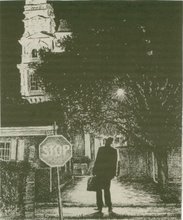
Peter Anastas, the Gloucester writer and activist, passed away quietly at 1:45am on December 27, 2019. The Gloucester Daily Times ran this feature on Saturday, December 28, and there will also be an obituary.
We will be posting more information about his memorial service this summer as plans develop. All friends and family will be welcome.
Saturday, December 28, 2019


Thursday, May 9, 2019
Jack Kerouac's The Haunted Life

Jack Kerouac’s The Haunted Life at the Merrimack
Repertory Theatre
Peter Anastas
“But we haven’t lived. We have only thought.”
--Jack Kerouac, The Haunted Life
Lowell, MA—A singular event in
Beat history is taking place in Jack Kerouac’s home town.
The Merrimack Repertory Theatre has, since March 20, been
staging to great acclaim a dramatization of Kerouac’s long lost novel, The Haunted Life. The production will run until April 14,
2019.
Written by Sean Daniels, the company’s outgoing artistic director,
and co-directed by Daniels and christopher oscar pena [sic], the play is based
on Kerouac’s second novel, believed by Kerouac to have been lost in a New York
taxi cab shortly after it was written, in 1944.
As it turns out, Kerouac actually left his only copy of the hand-written
manuscript in the closet of Allen Ginsberg’s dormitory room at Columbia. Discovered later, and held in private hands
until 2002, the manuscript re-surfaced in a Sotheby’s auction catalogue in New
York, where it eventually sold to an unnamed buyer for $95,600, according to U-Mass
Lowell English professor Tod Tietchen, who edited the novel for publication in
the US by Da Capo Press, in 2014.
The novel, as published, is a nearly 100 page integral
text, meant by Kerouac to be the first section of a longer novel that was never
completed. Instead, Kerouac went on to write his first published novel, The Town and the City (1950), in which the story of the Martin
family, begun in The Haunted Life and
based on Kerouac’s own French Canadian family, is given fuller treatment.
What is so important about The Haunted Life for an understanding of Kerouac’s oeuvre, is that in this early manuscript
nearly all of the major themes of the work to come are present—the yearning to
move, to travel, to be on the road; the tension between Kerouac’s attachment to
his family and home town and his desire to free himself from both; and his
desire for important intimacy in conflict with his need to set all
entanglements aside in order to write. There is also Kerouac’s incredible sense of
place: the Lowell streets on summer nights, talk from neighborhood porches,
trees shaking in soft breezes, and the silence followed by the thunk of bat on
ball from nearby ballgames.
The novel—and the play—focus on Peter Martin, Kerouac’s
stand-in, and his family. Peter is home
for the summer after his first year at Boston College, where he has
matriculated with the help of a track scholarship. Peter reads Thomas Wolfe, William Saroyan,
and the proletarian novelist Albert Halper.
He reconnects with his high school love Eleanor; and he and his best
friend Garabed, based on Kerouac’s friend Sebastian Sampas, talk about the
books they will write and the travels they will embark upon around the world. What neither of them know, as they walk the
streets of Lowell until dawn, is that Garabed will eventually be killed in
action on the beach at Anzio in the Second World War. It is a loss that Kerouac will never fully
recover from.
Peter is compelled to listen to his father, a Trump-like
figure and owner of a failing print shop, who attacks the immigrants who’ve come
to Lowell as degenerates that are destroying the city. The father’s virulent racism, as war rages in
Europe and will soon involve America, increases Peter’s sense of feeling
haunted. He is haunted by the books he
wants to write, the places he hopes to visit, the sex he yearns to experience, and
the call of big cities like New York.
What haunts him equally is the possibility of joining the Merchant
Marines, which he and Garabed talk excitedly about, along with the war itself,
which his friend Dick Sheffield urges Peter to participate in by enlisting in
the army (Peter will later be haunted by Sheffield’s death).
As Peter
recollects:
“This
was the last of his magnificent summers… Something grave and perhaps terrible
was impending, the war maybe, or some violent change in the structure of his
[Lowell] world.”
The novel leaves Peter with his personal issues and the
pressures on him unresolved. What writer
and co-director Daniels have been able to achieve by the use of Kerouac’s
writings about his novel-in-progress, including an existing outline for its
completion and correspondence made available by the Sampas family of Lowell, is
a play that transforms an intimate yet incomplete novel into a vibrant play. Daniels has also been able skillfully to incorporate
Kerouac’s lyrical descriptions of life in pre-war in Lowell, along with much of
the narrative itself into the dialogue of the play and the directly spoken
thoughts of the characters that connect the viewer with the time and place of
the drama:
“Soon
it would be summertime dusk. Voices
below rose softly in the air. A tender shroud was being lowered on his life.
With the darkness and the smell and feel of it would come the sounds of the
suburban American summer’s night—the tinkle of soft drinks, the squeaking of
hammocks, the screened-in voices on dark porches, the radio’s staccato
enthusiasm, a dog barking, a boy’s special nighttime cry, and the cool swishing
sound of the trees: a music sweeter than anything else in the world.”
Daniels’
The Haunted Life is staged in two
acts. The setting consists of a backdrop of windows that appear to represent
the windows of the tenements Kerouac grew up in, or the mills and factories of Lowell, which Kerouac himself
described as “eyes” looking out on the world and through which the workers of
Lowell peered daily.
In keeping with the MRT’s reputation for world-class
theatre, each of the actors has worked regionally as well as nationally, and
many internationally. Their resumes,
described in the play’s attractive program, are impressive.
Peter
Martin is played by Raviv Ullman, who not only looks like the young Kerouac but
speaks as he must have. Joel Colodner plays Peter’s father Joe, gruff
and opinionated but with a tender side.
Peter’s long-suffering mother is portrayed by Tina Fabrique. Vichet Chum is precisely how one might imagine
Garabed to be while reading the novel; and Caroline Neff is an ideal Eleanor,
who loves Peter but learns to protect herself from his conflicted and wandering
spirit.
Kerouac
is in good company at the Merrimack Repertory Theatre. Founded in 1969, this versatile company has
mounted prize winning productions of Waiting
for Godot, Hamlet, Harold Pinter’s Homecoming,
Marsha Norman’s ‘Night Mother,
canonical plays by Eugene O’Neill, Tennessee Williams, and Arthur Miller, and a host of exciting plays by new
writers.
In recent years, the theatre has held a staged reading of
Kerouac’s only play, The Beat Generation,
the script of which was discovered in a New Jersey warehouse, in 2005, and a full production of Kerouac’s
bittersweet Lowell novel, Maggie Cassidy.
But all the stops were pulled out for the MRT’s stunning
production of The Haunted Life, created
in collaboration with Jim Sampas and the Estate of Jack Kerouac. One
came away from the play with a sense that Kerouac had been given both the
attention and the respect due him and his work by his hometown. You could enjoy the play without ever having
read a word of Kerouac. This would not
prevent you from feeling in awe of the writer’s early struggles to become one
of America’s most original novelists, in the face of family strife, impending
war, and the attractions of the new bohemia emerging in New York and San
Francisco. If you had read Kerouac and
knew him through his books and the numerous biographies that tell his story, you
would emerge from the play with an
even deeper understanding of how seriously Kerouac lived his writerly
vocation. The seeds of everything Jack
Kerouac would become may be found in both the novel and the play. But in the play we participate in ways
that only a beautifully made and staged drama can make us see and feel what the
words on the page open us to: the pathos of a major writer’s life.
(This review appears in the
Spring 2019 issue of Beat Scene, UK)
Tuesday, April 16, 2019
Stamford '76

Stamford
’76: A True Story of Murder, Corruption, Race and Feminism in the 1970s, by
JoeAnn Hart (U. of Iowa Press, 2019)
Peter Anastas
“A black
drug dealer almost certainly killed his white girlfriend, then got killed
himself by a police officer during an armed robbery. What could I possibly hope to accomplish by
writing that story? Nothing. I had to
shape meaning out of what seemed be to meaningless violence.”
--JoeAnn
Hart, Stamford ‘76
Among a
writer’s books there are those that come to us naturally. But almost always there is another kind of
book. It is not the book we write, but the book that writes us. We may be at the keyboard or with pen in
hand, but there is another force driving us to put down words on a page. It may
be a voice from the past urging us on, or the pressure of a traumatic event,
the outlines of which are still unclear.
It may be a story we have long wanted to tell, if only we could find a
way to tell it, or we could discover certain details that have remained hidden
or even unknown to us.
When we
do tell this story, we often discover that it is a story as much about
ourselves as its elusive subject or characters. Often we find out that we are trying to learn
more about who we were at the time of the story and, as a consequence of the
telling, who we are now—who we have become.
Hence, we are written as we write.
This is
one of the themes of Gloucester writer JoeAnn Hart’s stunning new book, Stamford ’76, published in April by the University
of Iowa Press.
It is a
book that works on many levels. As
memoir, Hart is writing about herself and her nuclear family in the context of
an interracial relationship she embarked on after dropping out of college in 1975,
at the age of 18, and moving to Stamford, Connecticut, where she found work in
bars and restaurants, and eventually in a bank.
Stamford ’76 can
also be read as a true crime story. Hart
and her black lover Joe Louis were friends with another interracial couple, both
of whom died violent deaths. The white
woman, 24 year old Margo Olson, was found in a shallow grave in an abandoned
potter’s field in Stamford, her heart pierced by a steel arrowhead. Her partner Howie, who may have killed her,
died at the hands of police during a botched liquor store robbery. The circumstances of their deaths remained a
mystery that haunted Hart for decades.
As Hart
writes: “Leaving behind the memory of Margo had meant forgetting parts of
myself, and I needed that eighteen-year-old by my side as I faced the challenge
of getting three children through their teenage years. I wanted to gain some wisdom from that girl,
who was both reckless and brave to a fault, and to do that I had to open the
box marked Fragile.
“In
that box,” Hart continues, “nestled along with all my stored emotion, was a
three-pronged mission, (1) figure out what had happened to Margo, (2), remember
what had been going on with me, and (3) try to understand why her death made me
so wary, for so long.”
This,
then, is the thrust of a narrative that is as revealing as it is riveting. It is here that Hart employs her superb
investigative skills in attempting to solve the question of Margo’s death as a “study
in silence,” and the abandonment of her body in a makeshift grave. Here, also, she uncovers the couples’
entanglement with drug dealing and organized crime. Equally, Hart unearths a
parallel story whose outlines were unclear to her at the time of her
involvement with Margo and Howie. And
that is the story of the growing presence of organized crime in Stamford, aided
and abetted by the local Democratic Party establishment and the participation in
criminal activities of certain key members of the Stamford police force,
including the drug trafficking that led to the deaths of Margo and Howie.
Having
published two novels (Addled, 2007,
and Float, 2013), along with numerous
essays, short stories, and works of journalism, Hart is an accomplished writer of fiction and
non-fiction. Everywhere in the narrative one experiences Hart’s novelist’s eye
for detail, which helps to give the book its powerful sense of immediacy.
Hart’s story
also has social and political implications.
At the time of the events described (and during the country’s
Bi-Centennial Celebrations), Stamford was undergoing extensive Urban Renewal,
so that the city could lure major corporations out of the nearby crumbling New
York City. In order to achieve this,
blacks and other minorities had to be pushed out of neighborhoods that had long
been theirs to make way for the high tax payers. As a consequence, race relations, strained during
the civil rights struggles of the 1960s, worsened, housing problems escalated,
and Stamford became a more problematic city to live and work in, as it turned “whiter
by the hour,” as Hart describes it.
Some of
this Hart learned while living and working in the city and involved with Joe
Louis, his family, and his friends, including Howie and Margo. There is a particularly affecting picture of
Joe’s jazz and gospel singer mother Georgia, with whom Hart remained close even
after Joe’s death. Though Joe had
graduated from Columbia, much of his income came from gambling, drug dealing
and flipping used cars. He also ran unsuccessfully
for public office. As a consequence,
Hart’s paychecks kept their often unstable living situations afloat. Joe also became an increasingly heavy drinker. A significant part of the narrative involves
Hart’s attempts to come into her own as a person and a woman under the aegis of
second-wave feminism, while trying to remain in a committed relationship. Though Joe did not readily speak about it,
the couple remained haunted by the deaths of Howie and Margo.
After
the couple finally separated and Hart was living in Colorado, about to meet the
man she eventually married, the story of Margo and Howie continued to affect
her. Her search for clues about their
deaths, particularly Margo’s, as Hart traveled back to Stamford during the
intervening years, searching through police records and the archives of the
Stamford Advocate, tracking down
people to speak with, and eventually writing about the case and her life in
Stamford, constitutes one of the most dramatic dimensions of a book that will
keep readers in suspense.
In the
end, after all of her careful research and brilliant detective work, Hart
returns to the potter’s field where Margo’s body had been found by
picnickers. It is there that she finally
experiences a sense of closure.
“I had
found Margo and with her, my younger self,” Hart concludes. But in the process of this act of recovery, readers
have shared the journey of a writer, who is as unrelenting in her pursuit of
self-knowledge as she is redemptive of her lost friends, who, in part, enabled
that important discovery.
_______________
JoeAnn
Hart will be reading locally from Stamford
’76 at the Gloucester Lyceum, on April 18, from 7 to 9 p.m. and at the
Gloucester Writers Center (Rocky Neck Cultural Center), on May 22, from 7:30 to
9 p.m. with discussion
Friday, October 12, 2018
An Open Map

(Peter Anastas and
Vincent Ferrini at Charles Olson’s apartment, 28 Fort Square, Gloucester,
January 1970; photograph by Charles Lowe, Gloucester
Daily Times, from the archives of the Cape Ann Museum)
Robert Berthholf
(Editor), Dale M. Smith (Editor), UNM Press, 2017.
Peter Anastas
“We also knew Olson as a
secret spy of all the Gods in disguise.
Walking around Gloucester as a big man in sloppy pants; hanging around
the bars; talking to the fishermen; shuffling around in the registry of deeds;
looking at old court records to find out who first stole the land from the
Indians; how much they got when they resold the land; and how the new owners
abused the land, subdivided it, killed the Indians and the animals; and how
their descendants continued exploiting their stolen property, and turned it
into inhuman plastic.”
--Allen Ginsberg, at Charles Olson’s funeral, January 13, 1970,
Gloucester, Massachusetts
I
read my first poem by Charles Olson in the pages of Vincent Ferrini’s magazine Four Winds as a high school student
during the summer of 1952. But I
came much later to Robert Duncan. In
college the Beats were my poets—Ginsberg, Corso, di Prima. When I returned from Europe in 1962, Duncan’s
name was prominent during nightly conversations at Olson’s 28 Fort Square
dinner table. Those who gathered to
discuss everything from James Joyce to JFK were expected to have read poets
like Irving Layton and Drummond Hadley, whose names often entered the talk that
usually began after Olson emerged from his bedroom at the dinner hour and
continued until early morning, when the whiskey had been exhausted and Olson
excused himself to spend the remainder of the night writing.
Don
Allen’s The New American Poetry, was
published in 1960. This seminal
authority became the handbook for an understanding of what had been written by
the Beat, Black Mountain and other vanguard poets, who replaced the academic
poets of the 1950s, like Lowell and Snodgrass, whom our teachers had without
success been urging us to read. If it
wasn’t Ginsberg, McClure or O’Hara, whose incendiary work came to us in the Evergreen Review, it was their
progenitors Pound and Williams, who excited us.
I
had not read Duncan’s poetry until that time, though I ought to have
encountered it in the Evergreen Review,
or in Cid Corman’s Origin, which I had
been given by Vincent Ferrini, one of the stalwarts at Olson’s table. Nevertheless, it was Olson’s mention of
Duncan as though he were among us, and his reading to us from Duncan’s letters
as soon as Don Whynott, the letter carrier, delivered them to the door of
Olson’s second-floor apartment, that sent me back to Allen’s indispensable
anthology, and hence to Duncan’s masterful The
Opening of the Field, which appeared in 1960, the same year that Olson’s The Distances was published, both by
Barney Rosset’s Grove Press.
Though
Olson carried on important correspondences in those years (1957-1969) after he
returned home from Black Mountain—his longest with Creeley and Frances
Boldereff, and a briefer but no less crucial one with avant-garde filmmaker
Stan Brakhage—his exchange of letters with Duncan, that began on September 9,
1947 and ended with the older poet’s death, on January 10, 1970, seemed of
paramount importance.
“Charles
is just like I am,” Duncan once said of his fellow poet. “He sits around and reads all day.” No one
read as much and as deeply as Olson, except possibly for Gerrit Lansing, who
left a library of over 20,000 volumes.
But Olson, who’d worked as a letter carrier in his adopted city (“people
want delivery”), was equally a writer of letters. “Don’t hesitate to use the mails,” Olson
often exhorted friends blearily on their way out of his kitchen door at dawn,
so that the conversation we had been engaged in all night could be sustained on
the page.
As
for Olson himself, he is still remembered as lumbering down Main Street
enveloped in a blanket—it was actually a Mayan Indian serape, acquired while
doing archeological and linguistic research in Yucatan in 1951 on a Wenner-Gren
Foundation grant. Since his days in
Washington at the Office for War Information, he had grown a thick mustache, and
his hair was tonsured like a monk’s. As
it whitened, he allowed it to grow long, often tying it in a ponytail. Along with the serape, he would wrap a moth
eaten Shetland sweater around his neck, summer and winter, to keep the chills
that assailed his massive frame at bay.
To
be with Olson in those years was to have lived intensely. One had a sense of what the Concord of
Emerson and Thoreau might have been like, the talk of books, the activism,
Olson’s attempt to live a life free of materialism—“in the midst of plenty walk
as close to bare.” In Concord, Emerson’s
“plain living and high thinking” was tested by the rise of the Abolitionist
movement, just as our city was being torn down around us by Urban Renewal (“renewal
by destruction”) and the nation was in turmoil over Civil Rights and opposition
to the war in Southeast Asia.
So
while the talk at Olson’s table was of poetry, or who would be visiting or had
visited Gloucester (Jack Kerouac, Ed Dorn, Robert Creeley, Amiri Baraka, Hettie
Jones, Michael McClure, Diane di Prima, John Wieners, Ed Sanders, Ann Charters,
among many others) to pay their respects to a poet who lived with his wife and
son in a $28 a month cold-water walk-up overlooking the city’s waterfront, the
background to our talk and the reading of letters, journals and books that
arrived daily in the mail, was the war raging a world away and the growing
opposition to that war in the country’s streets.
Such
were the times: and I can only mark them here as an era of turmoil, during
which we watched our republic falling apart, just as we experienced some of its
greatest achievements in the work of writers and visual artists, whose poetry
and paintings continually energized our conversations, keeping us sane in a
world we believed gone mad.
There
was a great spontaneity about Olson, along with a huge thirst for knowledge,
for getting it right, even if it kept him and his friends up all night. I remember one day—oddly in the afternoon—he
called me over to his house to help him translate some passages from Hesiod’s Theogony (Smith kindly mentions my
knowledge of Ancient Greek in the notes to these letters). The gigantic poet was in bed—he often took to
his bed when life got to be overwhelming, or when he needed to be utterly
isolated so that he could work in peace.
I
knocked quietly on the door to be let in by his second wife Betty, mother of
Charles Peter, soft spoken with raven hair piled high on her head, the delicate
abstract paintings she was working on spread out on the floor of the room
between the kitchen and Olson’s study-bedroom.
She led me to Charles who sat up in bed surrounded by stacks of
books—the original texts of Hesiod’s Theogony,
his Greek-English lexicon, some hand written lines of a poem in which he hoped
to quote Hesiod.
“I’m
stuck on a phrase,” he said, making room for me to join him on the double
bed. He was in pajamas—Betty told me
he’d only left the bed to eat and use the bathroom, he was so intent on the
poem. He smelled of the cigarettes that never seemed
to leave his fingers. We got to work,
comparing the Loeb translation with Olson’s reading word by word. I experienced first-hand how Olson’s mind
worked, grasping for an idea or insight, rejecting it, checking the definition
of a word in his Oxford dictionary, or
maybe the big Webster’s that lay open on his immense work table. What were the roots? How might Hesiod have employed the word or
phrase, Homer? (Olson’s bible was Victor Berard’s 1931, Did Homer Live?, his copy made illegible by marginalia).
In
retrospect, I do not know how helpful I was to Olson, but in encounters like
the one I describe I observed one of America’s most original minds in action,
to such an extent that I received an education I could never have obtained in
graduate school, which I soon abandoned.
Olson’s
kitchen had a gas-on-gas range that heated only that room. There was a rusted kerosene stove in his
study and some electric space heaters scattered around the flat, always damp
from the fog off Gloucester harbor. On the
walls were coast and geodetic survey charts of Cape Ann and the Gulf of Maine,
and a street map of Gloucester on which Olson pinned notes about who had lived
where, and when. At the center of that
map was Dogtown, Cape Ann’s vast, wild interior, whose mythic origins Olson
counterposed to the maritime history of the city (“go inland, the city is
shitty…”)
Often
at the table, along with Ferrini, whom Olson had met in 1949, when he paid a
“fan call” to the former General Electric bench hand at his Liberty Street
home, after reading a poem of Ferrini’s in a literary magazine, was Jonathan
Bayliss, a Harvard and Berkeley educated novelist and playwright, who made his
living as a market analyst at Gorton’s, Gloucester’s principal seafood company;
Gerrit Lansing, also Harvard, whose exquisite poetry was just then beginning to
be published; and painter Harry Martin, at whose studio on Main Street the
group from Olson’s kitchen often spilled over to, along with whoever else
happened to be visiting—once it was Harry’s friend Patrick Balfour, the 3rd
Baron Kinross.
This
then is the setting: Olson’s dinner on the table, which he picked at while
talking, smoking and drinking; the day’s cache of mail, from which he read us a
prize letter from Duncan when it arrived, or from J. H. Prynne; dozens of
little magazines in German, French and Japanese; and the other correspondence
from writers of his acquaintance going back to Harvard and Washington, D.C.,
from Black Mountain students and friends; though much of it came from readers
he did not know, but who, having discovered a Maximus Poem in one of the many journals where the poems often
appeared (including Ed Sanders’ Fuck You:
A Magazine of the Arts) were prompted to write Olson.
I
linger over these details to help you see what it was like to be around Olson
in those fruitful years before Betty’s accidental death in Buffalo and his
wanderings away from Gloucester to teach and read in the larger world. For the atmosphere in which Olson lived and
wrote, and into which letters like those from Duncan dropped, letters that fueled
and informed the dialogue that kept Olson writing and thinking about the
process of writing, was as much a part of the poetry as his night-long reading
in the Quarterly Court Records of
Essex County, where he found details of
the daily life—who sued whom for slander, which husband left his goods
and chattels to his second wife; who had encroached on whose property, or
stolen prize pears from a neighbor’s tree—in which the poetry was grounded.
While
it is true that the most important phase of the correspondence occurred before
Olson had returned to Gloucester, the years in which he and Duncan grappled
with the work of creating a new poetics, the letters of the Gloucester years,
though less frequent, are no less significant.
Looking
back, it now seems to me that our talk and the endless conversations Olson had
with other friends and visitors was like a holiday for the poet, a time and
place for letting his hair down, for sharing what he had been thinking, trying
it out among contemporaries who were open to it; while the real work of
thrashing out the methodology through which the great Gloucester epic was
expressed took place in Olson’s voluminous correspondence. There was the reading, too, the work of
intense and deeply mined research; but it was in the correspondence that Olson
was utterly himself. To turn the pages of An Open Map, is to discover two major
poets, possibly the most important of their time, connecting intellectually and
through their delight in language, in ways that in our era seem nearly
impossible.
It
is difficult to find a finer premise for these letters than in the introduction
to the collection by Smith and Bertholf, where the editors describe the
correspondence as “one of the foundational literary exchanges in American
poetry in the second half of the twentieth century.” Duncan and Olson are said to have “met each
other with huge accomplishments, an inquiring declarative intelligence, wide
ranging interests in history and occult literature, and the urgent demand to be
a poet.” Struggling together “to
articulate a new basis for poetics, their shared goal was to reestablish the
uses of poetry beyond the domain of literature, to confront a large cultural
and historical field of action.”
As
the editors equally assert, both poets favored the open approach “in resistance
to New Criticism and to the models of closed form verse then promoted in
academia and the literary public sphere.”
In other words, the verse they were each striving to achieve was open,
not unlike the manner of Pound’ s Cantos,
to whatever was happening or had happened in the world around them, personally
in their own lives, and also to what they were reading, or what had simply
occurred to them daily: a word on the street, a newspaper article, or an
inquiry from a friend or reader.
There
is nothing that seems to have escaped them in their struggle to make a poetry
that was both original (Olson’s “projectivity,” Duncan’s “thinking of my own
going at it along a literary voice”) and resonant. So while Duncan writes on
January 9, 1963, “in vegetative terms I’m likely to luxuriate; not, here, to go
beyond my roots, for I put out roots as richly as I put out branches: but to go
outside of my seed,” Olson responds
with a quotation from one of his most powerful poems: “I have this sense/that I
am one/with my skin.” For both poets the
body was central, as ground of being, as Olson had explored in his essays on
Proprioception, and Duncan had written about in his masterful poem Groundwork: “Now so late that my
body/darkens and the gossip of years/goes on loosening the tides of/my
body.” “I now lie in a dark of my
own/nursing my body’s unquiet watch.”
While
there were few face to face meetings between the two poets, the correspondence
promoted a closeness, a sense of collegiality that could hardly be imagined now
in the illusory intimacy of the internet.
“I miss your spirit in in my life,” Olson, lonely and declining in
health, wrote to Duncan in April of 1968, seven months before his diagnosis of liver
cancer, “and got part of it reading your piece on Dante…got it right beside me
now,” And on December 18, 1969, Duncan responded, as his friend lay dying in
New York Hospital: “It is a beautiful music for these here ears, and a music
that is thruout, a melody of idears [sic] (as vision we hear must be.”)
There
was much that was new to me during those years in Olson’s kitchen, much that I
did not understand; but reading this immaculately edited collection of letters
between Olson and Duncan it all comes back to me with a stunning sense of
revelation, of deep humility and gratitude for what I was privileged to have
participated in.
(This review first appeared in Beat Scene, #90, Late Summer 2018)
Subscribe to:
Posts (Atom)